Introduction: A Temporary Relief or a Structural Signal?
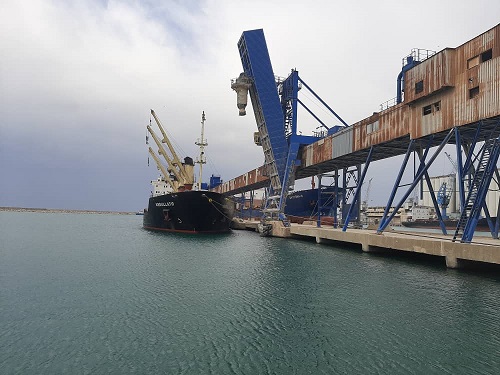
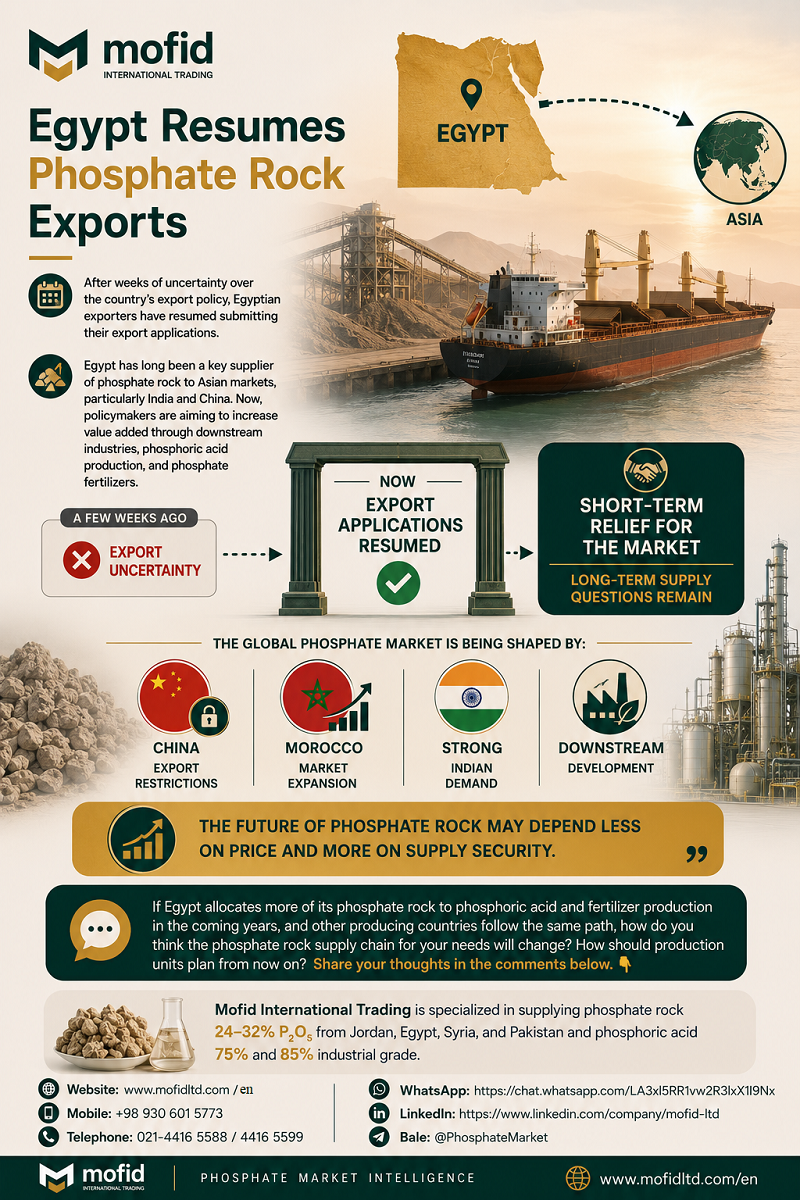
After several weeks of uncertainty surrounding Egypt’s phosphate export policy, rock phosphate exporters have resumed submitting export requests. This development suggests that shipments from Egypt are likely to continue in the short term, easing immediate supply concerns in the global phosphate market.
However, beneath this short-term relief lies a much deeper structural question about the future of global rock phosphate availability and trade flows.
Egypt’s Role in the Global Rock Phosphate Market
For decades, Egypt has been one of the key suppliers of rock phosphate to international markets, particularly to India and China, two of the largest importers of phosphate-based fertilizers.
Egyptian rock phosphate, typically in the 26–30% P₂O₅ range, has played a strategic role in balancing global supply, especially during periods of tight availability from other origins.
However, the country’s long-term strategy appears to be shifting.
Shift Toward Downstream Value Addition in Egypt
In recent years, Egyptian policymakers have increasingly focused on maximizing value from phosphate resources rather than exporting raw material.
This includes expanding investments in:
- Phosphoric acid production
- DAP (Diammonium Phosphate) manufacturing
- MAP (Monoammonium Phosphate) production
- Integrated phosphate fertilizer complexes
If this strategy continues to develop, Egypt may gradually reduce its dependence on raw rock phosphate exports and move further into higher-margin downstream products.
Key Question for Global Rock Phosphate Consumers
This structural shift raises a critical long-term question for global buyers:
📌 Will the volume of rock phosphate available on the international market today remain the same in five years?
This question is becoming increasingly important as global supply dynamics evolve.
Global Market Context: Tightening Supply Dynamics
The timing of Egypt’s policy uncertainty and partial export normalization coincides with several important global market trends:
- China continues to maintain restrictions on phosphate exports
- Morocco is strengthening its dominance in global phosphate supply
- India’s phosphate fertilizer demand remains structurally strong
- Many phosphate-producing countries are prioritizing domestic processing over raw exports
Together, these factors are gradually reshaping the global rock phosphate market.
From Price-Driven to Supply Security-Driven Market
Traditionally, the rock phosphate market has been largely price-driven, with buyers focusing on cost per tonne, freight, and short-term arbitrage opportunities.
However, the current structural shift suggests a transition toward a supply security-driven market, where:
- Long-term availability becomes more important than spot pricing
- Supply diversification becomes a strategic necessity
- Long-term contracts gain importance over short-term purchases
- Geopolitical and policy risks play a larger role in sourcing decisions
Short-Term Relief, Long-Term Uncertainty
The decision to resume Egypt rock phosphate exports may provide short-term stability to the market by easing immediate supply concerns.
However, it does not eliminate the broader structural uncertainty surrounding:
- Long-term export volumes
- Domestic consumption growth in producing countries
- Industrial policy shifts toward value-added phosphate products
In fact, it may only delay a deeper transformation already underway in the global phosphate industry.
A Broader Industry Transformation
A growing number of phosphate-rich countries are now asking a strategic question:
Should phosphate rock continue to be exported as a raw material, or should it be processed domestically into higher-value products such as phosphoric acid and fertilizers?
This shift, if accelerated, could significantly reshape global trade flows and reduce the availability of freely traded phosphate rock in international markets.
Implications for the Global Fertilizer Supply Chain
If major phosphate producers increasingly move toward downstream integration, the global market could experience:
- Reduced availability of phosphate rock for export
- Greater competition for remaining export volumes
- Increased importance of long-term supply agreements
- Higher sensitivity to geopolitical and policy decisions
- Rising importance of securing diversified supply sources
How Should Market Participants Prepare?
For fertilizer producers, phosphoric acid manufacturers, and industrial consumers, the emerging environment requires a more strategic approach:
- Securing long-term supply contracts
- Diversifying sourcing regions
- Monitoring policy shifts in key producing countries
- Evaluating supply chain resilience beyond price considerations
- Investing in upstream integration where possible
Conclusion: A Market in Transition
Egypt’s resumed rock phosphate exports may appear to signal stability, but the broader market picture suggests a sector in transition.
The global rock phosphate industry is gradually moving from a commodity-based pricing system toward a strategic resource allocation system, where control over supply is becoming as important as production itself.
What Is Phosphate Rock?
Phosphate rock is a naturally occurring mineral containing significant concentrations of phosphorus pentoxide (P₂O₅). It is the primary raw material used to produce phosphate fertilizers and various chemical products.
Most phosphate rock is extracted from sedimentary deposits and comes in different grades such as 26%, 28%, 30% P₂O₅, and higher.
Geochemically, phosphate rock is rich in apatite minerals and may contain calcium, magnesium, iron, and trace elements. Its purity directly affects the efficiency of chemical processing and fertilizer production—making source selection critically important.
Applications of Phosphate Rock
Phosphate rock is used across several major industries:
1. Fertilizer Production
Over 80% of the world’s phosphate rock is used to produce fertilizers such as:
- DAP (Diammonium Phosphate)
- MAP (Monoammonium Phosphate)
- TSP (Triple Superphosphate)
These fertilizers are essential for improving soil fertility and crop yields.
2. Phosphoric Acid Production
Phosphate rock is the main feedstock for producing both industrial-grade and food-grade phosphoric acid, which is a key building block in numerous chemical and pharmaceutical products.
3. Industrial and Food Applications
Phosphate-derived products are widely used in detergents, animal feed, specialty metals, ceramics, and various chemical industries.
Our Services in Phosphate Rock Supply
In a complex and rapidly evolving global minerals market, we provide comprehensive and professional sourcing solutions for high-quality phosphate rock from top-tier producing regions.
Direct Supply from Leading Origins
We maintain direct access to key producers in Jordan, Egypt, Syria, and West Africa, enabling us to offer the right grade to match your exact requirements.
Flexible Supply Volumes
Whether you need small pilot-scale quantities or large industrial shipments, we offer full logistical capability to support your operations.
Customized Packaging Options
Available packaging includes bulk, jumbo bags, 50-kg bags, or fully customized options.
Reliable, Transparent, and Cost-Effective Delivery
Through partnerships with reputable shipping and clearance providers, we ensure timely, secure, and transparent delivery to your destination.
Contact Us
For expert consultation, market analysis, or sourcing phosphate rock from multiple origins, feel free to reach out to Mofid Ltd anytime.