After weeks of uncertainty caused by disruptions to maritime transportation, the global fertilizer market is finally seeing encouraging signs of recovery. Fertilizer shipments and key raw materials are gradually moving again through the Strait of Hormuz, easing concerns over supply chain interruptions.
While the market has not yet returned to normal, these developments represent an important step toward restoring the global flow of phosphate fertilizers and their essential feedstocks.
Fertilizer Shipments Resume Through the Strait of Hormuz
According to the latest market reports:
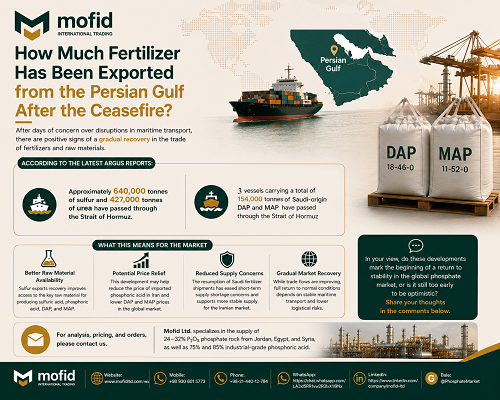
- Approximately 640,000 tonnes of sulfur have transited the Strait of Hormuz.
- Around 427,000 tonnes of urea have also been exported from the Gulf.
- Sulfur cargoes are heading to major importing countries, including Morocco, China, Indonesia, and Tanzania.
- In addition, three Saudi vessels carrying a combined 154,000 tonnes of DAP and MAP have successfully passed through the Strait after delays and are now sailing toward key destination markets, particularly India.
These figures indicate that fertilizer trade in the region is gradually recovering, although logistics have not yet returned to full capacity.
Why Are Sulfur Shipments Important for the Phosphate Industry?
At first glance, sulfur exports may appear unrelated to the phosphate market. In reality, sulfur is one of the most critical raw materials in the phosphate fertilizer production chain.
Sulfur is processed into sulfuric acid, which is then used to manufacture phosphoric acid—the essential intermediate for producing phosphate fertilizers such as DAP (Diammonium Phosphate) and MAP (Monoammonium Phosphate).
As sulfur availability improves, phosphate producers can expect:
- Better access to essential raw materials.
- Lower production pressure for sulfuric and phosphoric acid.
- Improved operating conditions for phosphate fertilizer manufacturers.
- Potential stabilization—or even easing—of global phosphoric acid and phosphate fertilizer prices.
What Does This Mean for Import-Dependent Markets?
Countries that rely on imported phosphoric acid and phosphate fertilizers could benefit significantly if Gulf exports continue to normalize.
Improved logistics may result in:
- More stable phosphoric acid supply.
- Lower procurement costs for DAP and MAP.
- Reduced supply risks for fertilizer manufacturers.
- Greater confidence in long-term purchasing and inventory planning.
Although the exact price impact will depend on future market conditions, the reopening of shipping routes is undoubtedly a positive signal for fertilizer importers worldwide.
Has the Global Phosphate Market Fully Recovered?
Not yet.
Despite the resumption of shipments, several challenges continue to influence the market:
- Shipping security in the Strait of Hormuz.
- Elevated freight and marine insurance costs.
- Delivery schedules and vessel availability.
- Ongoing geopolitical uncertainty.
As a result, logistics remain one of the key variables shaping fertilizer prices and supply reliability.
Conclusion
The successful shipment of 640,000 tonnes of sulfur, 427,000 tonnes of urea, and 154,000 tonnes of Saudi DAP and MAP marks the first significant sign that fertilizer trade through the Persian Gulf is recovering.
For the phosphate industry, this is encouraging news. Improved sulfur availability supports phosphoric acid production, while renewed fertilizer exports help reduce immediate concerns over supply shortages.
However, the market has not yet reached full stability. Until maritime logistics return to consistent and predictable operations, supply chain risks will remain an important factor influencing global phosphate, phosphoric acid, and fertilizer markets.
For fertilizer producers, phosphate rock buyers, and industrial consumers, monitoring geopolitical developments and shipping conditions may now be just as important as tracking fertilizer prices themselves.
What Is Phosphate Rock?
Phosphate rock is a naturally occurring mineral containing significant concentrations of phosphorus pentoxide (P₂O₅). It is the primary raw material used to produce phosphate fertilizers and various chemical products.
Most phosphate rock is extracted from sedimentary deposits and comes in different grades such as 26%, 28%, 30% P₂O₅, and higher.
Geochemically, phosphate rock is rich in apatite minerals and may contain calcium, magnesium, iron, and trace elements. Its purity directly affects the efficiency of chemical processing and fertilizer production—making source selection critically important.
Applications of Phosphate Rock
Phosphate rock is used across several major industries:
1. Fertilizer Production
Over 80% of the world’s phosphate rock is used to produce fertilizers such as:
- DAP (Diammonium Phosphate)
- MAP (Monoammonium Phosphate)
- TSP (Triple Superphosphate)
These fertilizers are essential for improving soil fertility and crop yields.
2. Phosphoric Acid Production
Phosphate rock is the main feedstock for producing both industrial-grade and food-grade phosphoric acid, which is a key building block in numerous chemical and pharmaceutical products.
3. Industrial and Food Applications
Phosphate-derived products are widely used in detergents, animal feed, specialty metals, ceramics, and various chemical industries.
Our Services in Phosphate Rock Supply
In a complex and rapidly evolving global minerals market, and as a reliable phosphate rock supplier, we provide comprehensive and professional sourcing solutions for high-quality phosphate rock from top-tier producing regions.
Direct Supply from Leading Origins
We maintain direct access to key producers in Jordan, Egypt, Syria, and West Africa, enabling us to offer the right grade to match your exact requirements.
Flexible Supply Volumes
Whether you need small pilot-scale quantities or large industrial shipments, we offer full logistical capability to support your operations.
Customized Packaging Options
Available packaging includes bulk, jumbo bags, 50-kg bags, or fully customized options.
Reliable, Transparent, and Cost-Effective Delivery
Through partnerships with reputable shipping and clearance providers, we ensure timely, secure, and transparent delivery to your destination.
Contact Us
For expert consultation, market analysis, or sourcing phosphate rock from multiple origins, feel free to reach out to Mofid Ltd anytime.